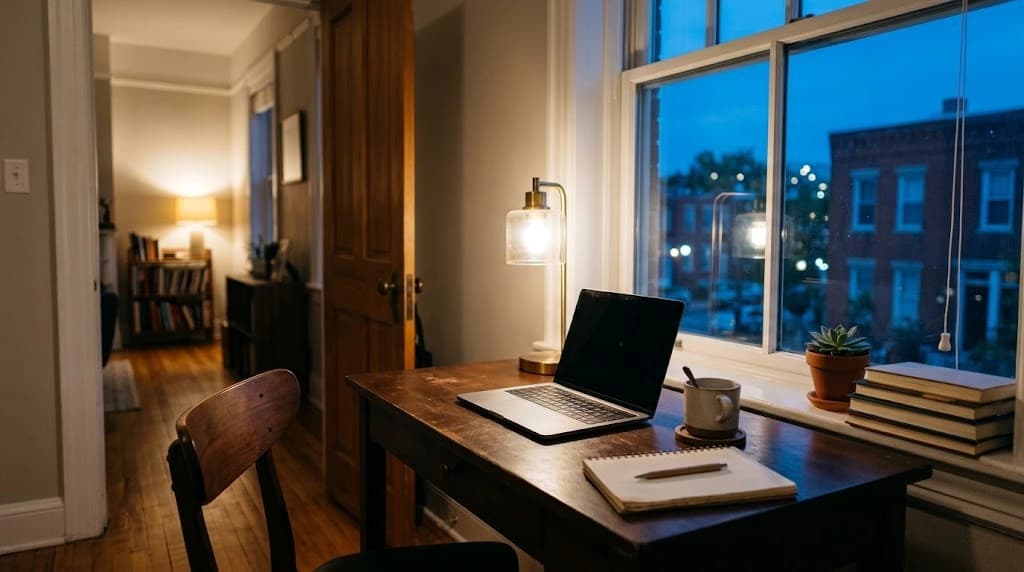
People who work from home usually describe the same slow drift. The job is fine. The commute is gone and they do not want it back. And somewhere in the last few years, the number of people they had an unplanned conversation with in an average week quietly fell to almost none.
Making friends when you work from home is harder than it was, for structural reasons rather than personal ones. The office was, for a lot of people, the last setting in adult life that produced friendships without anyone deciding to make one. Most of us did not notice the mechanism until it stopped.
What the office was actually doing
Sociologists keep arriving at a short list of conditions that make close friendship likely: proximity, repeated and unplanned interaction, and a setting where people feel able to let their guard down. The list is the sociologist Rebecca G. Adams's, popularized by Alex Williams's New York Times reporting on adult friendship, which he discussed on NPR. They are the same three conditions that made school so good at this.
A workplace supplied all three at once, for free, most days of the week, for years at a time. You did not choose those people or schedule them. You stood near them at a printer, left at the same time, sat through the same tedious meeting and caught someone's eye. The friendships were a byproduct of a building.
Remote work removed all three at once. Proximity went first, obviously. Repetition survived in a thinner form — the same faces in the same grid — but the unplanned part did not, because nobody arrives early to a video call and nobody lingers after it. And the guard-down setting went too. A scheduled call is a performance in a way that a walk to the parking lot is not.
Nothing replaced it, because nothing had been deliberately put there.
How many people this now applies to
In 2025, 35 percent of employed people in the U.S. did some or all of their work at home on the days they worked, according to the Bureau of Labor Statistics' American Time Use Survey. In 2019, before the pandemic, that figure was 24 percent. Among workers with a bachelor's degree or higher, the 2025 figure is 51 percent.
Be honest about the research
This is the point where a post like this usually reaches for a frightening statistic about remote work and loneliness. The evidence is thinner and more mixed than the headlines suggest.
The most direct recent test I can find is a 2025 study in Occupational Medicine by Weng In Leong and colleagues, Remote work and mental health among employed US adults, using repeated cross-sectional Household Pulse Survey data from September 2022 to October 2023 and a final sample of 116,806 people. Its opening line is worth quoting: "Existing research presents mixed findings regarding the effect of remote work on mental health, suggesting both beneficial and adverse outcomes."
Its own findings point both ways. People working remotely one to two or three to four days a week had slightly lower odds of depression risk than people not working remotely at all (adjusted odds ratio 0.98). People working five or more days remotely had slightly higher odds of anxiety risk (1.02). Those are one and two percent shifts, and the authors say longitudinal work is needed before anyone talks about causation. Their tentative reading is that hybrid may be the healthier arrangement.
The clearest thing anyone has actually measured is narrower. In The effects of remote work on collaboration among information workers, published in Nature Human Behaviour in 2022, Longqi Yang and colleagues tracked 61,182 U.S. Microsoft employees through the first six months of 2020 and found that firm-wide remote work caused collaboration networks to become more static and siloed, and communication to shift toward asynchronous media. That is one company, in the opening months of a pandemic, measuring work communication rather than friendship. It is still the most useful result available, because it names the mechanism: fewer new connections, fewer bridges, less live contact.
So I am not going to tell you that working from home is making you lonely. The honest, narrower claim is this. The number of unplanned in-person contacts in an ordinary week has fallen a long way, and unplanned in-person contact is the raw material friendship is made from.
What it costs, measured in hours
Jeffrey Hall, a communication studies researcher at the University of Kansas, tried to put a number on how long friendship takes. Across two studies, published in the Journal of Social and Personal Relationships and summarized by KU, he estimated roughly 50 hours together to move from acquaintance to casual friend, about 90 hours to become friends, and more than 200 hours to become good friends.
One detail there matters more than the headline. Hours spent working alongside someone counted for less than hours spent doing something unstructured together. Even in the office, the friendships were not made in the meetings. They were made in the twenty minutes around them — which is precisely the part remote work deleted.
The national picture points the same way. The U.S. Surgeon General's 2023 advisory, Our Epidemic of Loneliness and Isolation, reports that average time spent alone rose from 285 minutes a day in 2003 to 333 minutes in 2020 — about 24 more hours a month — while time spent socializing in person with friends fell from 60 minutes a day to 20, about 20 fewer hours a month. Those figures run to 2020 and describe a trend well underway before anyone had heard of a hybrid schedule. Remote work did not start this. It removed one of the last things holding it back.
How to make friends when you work from home
Everything below manufactures on purpose what a building used to supply for nothing.
Pick one recurring thing and defend it like a meeting. A weekly class, a league, a monthly volunteer shift, a choir. The activity matters far less than the fact that the same people are there again next week. A mediocre weekly class beats a brilliant one-off every time.
Do not put all your hope in your colleagues. Since shared work counts for less than shared leisure, a job — remote or not — is a slow route.
Replace the commute with a fixed reason to leave the house. A coworking day, a library afternoon, a gym class at the same hour each week, the same coffee shop on the same morning. It does not have to be social. It has to be regular and in public.
Take the small interactions seriously. Gillian Sandstrom and Elizabeth Dunn found, in Personality and Social Psychology Bulletin, that people reported greater happiness and greater feelings of belonging on days when they interacted with more weak ties — acquaintances rather than close friends. In a separate study, people who had a real exchange with a barista instead of being as efficient as possible felt more positive afterward. Those are not friendships. They are the difference between a silent week and a week with people in it.
Go back a fourth time. Nothing feels like anything at two visits, which is exactly when most people quit.
Say the second sentence. "That was good, are you here next week?" A lot of promising connections die because both people assumed the other was not interested.
The part nobody warns you about
Nobody tells you, when you start working from home, that it removes a social life you never counted as one. It rarely registers as a loss, because nothing dramatic happens. There is just a Thursday, eventually, when you notice you have not had an unscheduled conversation with anyone in two weeks.
Being deliberate about fixing that feels faintly embarrassing, as though needing to plan friendship means something has gone wrong with you. Nothing has gone wrong with you. The conditions changed, and intent now has to do the work a floor plan used to do.
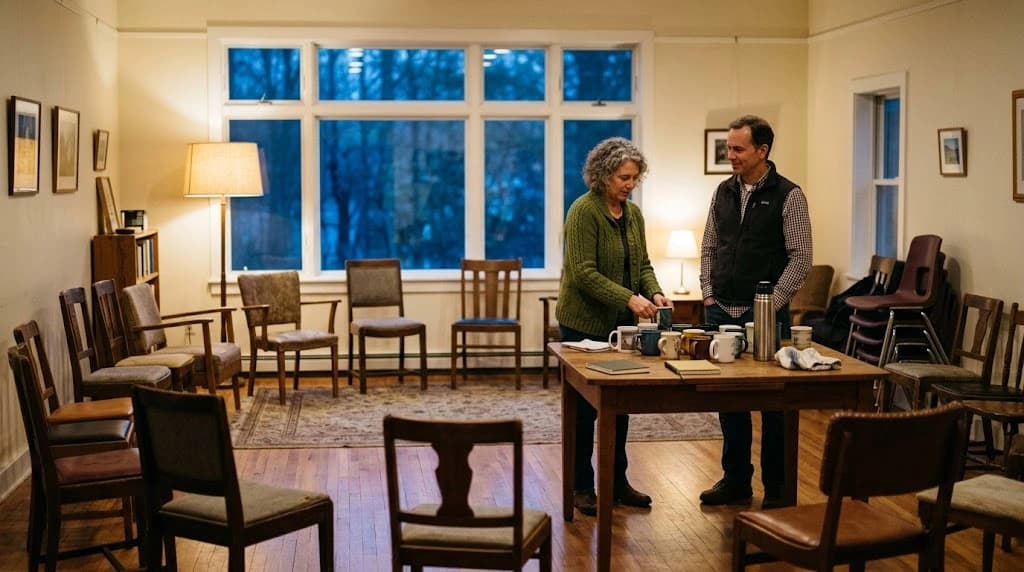
If you are in South Jersey or the Philadelphia area, that is the gap 5 Degrees was built for — small, free gatherings where you sit in a group of four to six people and actually talk. Most people come alone. Dates are on the events page.
The mechanism is the same wherever you find it. The same people, often enough, somewhere you are not performing.