Six months after a move, most people arrive at the same private conclusion: something must be wrong with them. They had friends before. They have none now. The obvious explanation is that they have become worse company.
That is almost never what happened. It is hard to meet people in a new city because the thing that made your old friendships possible was never portable in the first place.
What you actually left behind
The Surgeon General's 2023 advisory, Our Epidemic of Loneliness and Isolation, uses a useful phrase for it: social infrastructure. The advisory defines it as the programs, policies and physical elements of a community that support connection — volunteer organizations, sports groups, religious groups, member associations, public transportation, housing, libraries, parks.
Read that list again and notice that every single item on it is tied to a place.
Your old friendships did not run on your personality. They ran on a gym you had been going to for four years, a bar where the bartender knew you, a colleague who introduced you to two other people, a neighbor who watered your plants, a running route where you kept seeing the same faces. You built that over a decade without noticing you were building it. Then you put it in a truck and it did not fit.
What survived the move is the part you can carry: your character, your interests, your willingness. What did not survive is the part that did most of the work.
Everyone else is already full
The second problem is that you arrived somewhere the sorting had already finished.
Sociologists have identified three conditions that make close friendships likely: proximity, repeated and unplanned interaction, and a setting where people feel able to let their guard down. The formulation is the sociologist Rebecca G. Adams's, and Alex Williams's New York Times reporting on adult friendship is what put it in front of most people who know it — he discussed that reporting on NPR. In a city you have lived in for fifteen years, all three are running quietly in the background. In a new one, none of them are running at all, and the people around you already have their needs met.
This is worth saying plainly because it is the part that feels most personal and is least personal. When somebody is warm to you and then does not follow up, it is usually not a verdict on you. It is that they have a full life in a place where they have lived for a long time, and you are new information.
How long it actually takes
There is a useful number here, and it comes from a study of exactly this situation.
Jeffrey Hall at the University of Kansas surveyed 355 adults who had moved in the previous six months and were trying to make friends in a new place, then ran a second study following 112 first-year students through their first weeks at a new school. Combining both, he estimated that it takes roughly 50 hours together to move from acquaintance to casual friend, about 90 hours to become friends, and more than 200 hours to become good friends. The KU summary of the research covers the method; the paper is in the Journal of Social and Personal Relationships.
Hall also found that hours spent working alongside someone counted for less than hours spent doing something unstructured together. So the new job, which is where most newcomers put all their hope, is a slower route than it feels like it should be.
Two hundred hours is about four hours a week for a year. That is not a discouraging number. It is a realistic one, and it explains why month four in a new city feels like failure when it is actually just month four.
How to meet people in a new city
You are not trying to make friends. You are trying to rebuild infrastructure, and friends are what the infrastructure produces. That distinction changes what you do on a Tuesday.
Commit to something that repeats before you commit to people. A weekly class, a Saturday run, a monthly volunteer shift, a league. The specific activity matters far less than the fact that the same people will be there next week. You are buying repetition, which is the ingredient the move destroyed.
Pick two things, not six. The instinct is to sample everything, and sampling gives you twenty acquaintances and no friends. Two things you attend fifty times will beat ten things you attend five times.
Treat the first two months as data collection, not results. Nothing will feel like anything for a while. If you judge a new activity on the basis of two visits, you will quit everything that could have worked.
Use the third-place test. Look for somewhere you can turn up alone, be recognized, and not have to explain why you came. Libraries, a specific coffee shop at a specific hour, a gym class with a fixed roster, a bar trivia night. The bar for a good third place is low: it just has to be somewhere you keep going back.
Say yes for the first year, even when you would rather not. This is temporary. You are seeding a network, and seeding requires a volume of low-quality contact that would be unnecessary later.
Ask locals what they actually do, not what is good. People will recommend restaurants. What you want is the thing they attend on a schedule — the pickup game, the Thursday market, the choir, the trail group. That is where the repetition lives.
Follow up once, explicitly. Newcomers are chronically vague. "We should do this again sometime" is not a plan. "Are you here next week?" is.
The bit that takes the longest
You will feel like a guest for about a year. Not lonely, exactly — just provisional, like the version of you that people here know is a summary rather than the whole thing.
That feeling lifts, but it lifts through accumulated hours rather than through any single breakthrough. There is no evening that fixes it. There is a Tuesday, eight months in, when you walk into a room and three people know your name and you stop noticing that you were nervous about coming.
It also helps to know that this is normal, and not a small problem. The advisory found that Americans now spend about 20 fewer hours a month socializing with friends in person than in 2003. You are trying to build something in a country that has, on average, been building less of it every year. The difficulty is real; it is just not about you.
One more option
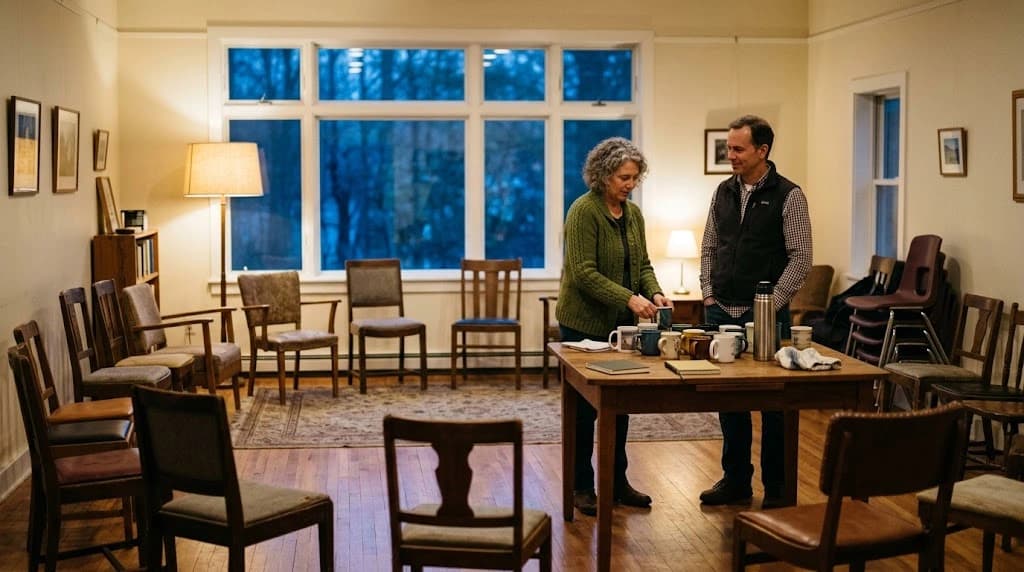
If you have moved to South Jersey or the Philadelphia area, this is what 5 Degrees was built for — small, free gatherings where you sit in a group of four to six people and have a real conversation, with a bit of structure so that coming alone is not awkward. Most people do come alone. Dates are on the events page.
It is one thread, not a whole net. The net still takes a year and a couple of hundred hours. But the first thread is the hardest one to throw, and it helps if somebody else has already set the room up.