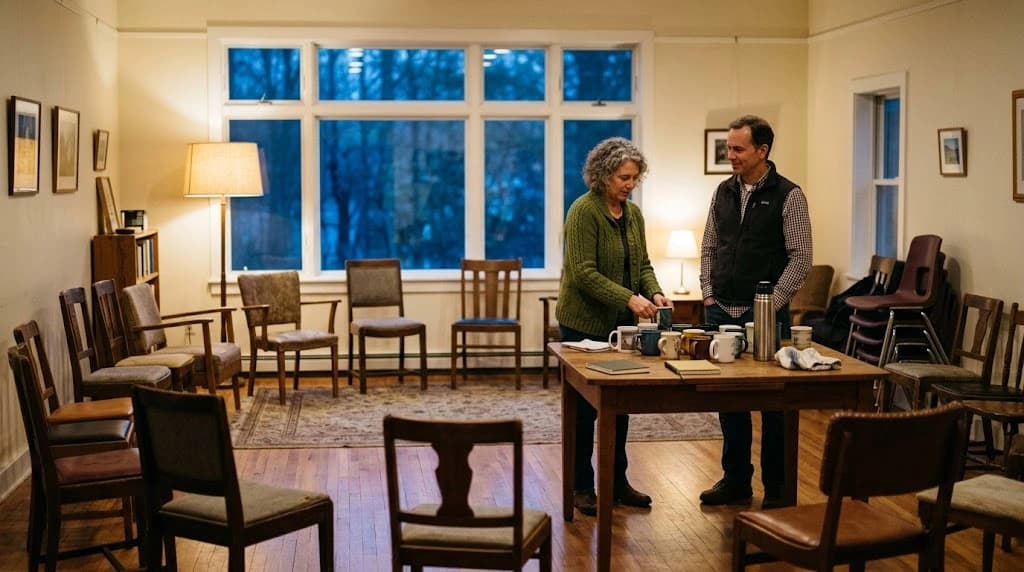
The single most common reason people don’t attend things is not the thing. It is the walk from the car to the door.
You know how it goes. You would like to go. You have checked the date twice. And then some part of you runs a short film in which you arrive, stand near a wall holding nothing, and everyone quietly registers that you came by yourself. So you stay home. Learning how to go to something alone is mostly a matter of finding out that the short film is wrong, and then having a small plan for the first ten minutes.
Three findings from social psychology are directly relevant here, and all three point the same way.
Nobody is watching you as closely as you think
In 2000, Thomas Gilovich, Victoria Husted Medvec and Kenneth Savitsky published The Spotlight Effect in Social Judgment in the Journal of Personality and Social Psychology. The famous version of the experiment asked students to put on a T-shirt with a picture of Barry Manilow on it — chosen because pretests confirmed it was embarrassing to that particular group — and then walk into a room of other people.
Afterward, the wearers were asked what proportion of observers would be able to say who was on the shirt. Their average estimate was 46 percent. The observers actually identified it 23 percent of the time — half as often.
The paper's explanation is that we anchor on our own vivid experience of ourselves and then fail to adjust far enough to account for the fact that everyone else is anchored on theirs. It is not that people are kind. It is that they are busy being self-conscious about their own arrival.
The practical translation: walking in alone is enormously loud inside your head and close to inaudible outside it. Roughly half the people you are sure have noticed you have not.
People like you more than you think they do
The second finding is, if anything, more useful.
In The Liking Gap in Conversations, published in Psychological Science in 2018, Erica Boothby, Gus Cooney, Gillian Sandstrom and Margaret Clark found that after a conversation, people systematically underestimated how much their partner had liked them and enjoyed their company. They observed it among strangers in the lab, among first-year students getting to know their dorm mates, and among members of the public at a personal development workshop. It held across short, medium and long conversations, and among the students it persisted for months.
In their words: after people have conversations, they are liked more than they know.
There is one more detail in the paper worth having. In the first study, shyness moderated the effect: the shyer people were, the larger their liking gap. People low in shyness barely showed one at all. That analysis rests on a small sample and should be held loosely, but the direction is worth knowing. If you are the sort of person who leaves an event replaying a conversation and wincing, you are probably the sort of person whose estimate is furthest off.
The conversation you are dreading is usually better than you expect
The third comes from Nicholas Epley and Juliana Schroeder's Mistakenly Seeking Solitude, published in the Journal of Experimental Psychology: General in 2014.
They asked commuters on trains and buses either to talk to a stranger near them, to deliberately stay in their own company, or to commute as usual. People who connected reported a more positive experience — and, notably, no less productive a one. A separate group of commuters, asked to predict how it would go, expected the opposite. They thought solitude would be the pleasanter option.
The authors trace the error partly to underestimating how interested other people are in connecting, which then stops anyone from finding out otherwise. That is a self-sealing loop, and the only thing that opens it is one conversation that goes fine.
What to do before you go to something alone
None of the above helps at 6:45 p.m. when you are sitting in the car. So here is the practical half.
Arrive early. This is the biggest one. Arriving late is the hard version nobody warns you about: you walk into a room that has already set, everyone is in a group, and there is no way in that does not feel like an interruption. Early, there are four people, none of them talking, all of them slightly relieved to see you. If you are anxious about a room, be one of the first three people in it.
Have two or three questions ready. Not clever ones. "How did you hear about this?", "Have you been to one of these before?" and "How far did you come?" will carry you through the first fifteen minutes of almost anything. Knowing you have them is most of the value; you will probably only use one.
Decide in advance what you will say about coming alone. "I came by myself" said plainly, with no apology attached, ends the topic instantly. It is treated as strange only if you treat it as strange.
Give your hands a job. This sounds trivial and is not. Get a drink, hold a program, put your bag on a chair. Empty hands are the physical form of not knowing what to do, and the fix costs nothing.
Talk to whoever else is standing alone. They are not a consolation prize. They are the person most likely to be glad you came over, and they are having the same evening you are.
Aim to talk to two people, not the room. Working a room is a networking skill and a miserable one. Two real conversations make a good night by any reasonable standard.
Say the specific thing before you leave. "Are you coming to the next one?" is worth more than an evening of pleasant circulating. Most promising connections die because both people assumed the other was not interested.
How to leave a conversation
The fear of getting stuck is a real reason people avoid events, and it is easily solved. Almost everyone accepts a clean exit, because almost everyone wants one occasionally themselves.
Say the true thing and add a reason: "I'm going to grab another drink — it was good to meet you." "I'm going to say hello to a couple of other people." "I should find my coat, but I'm glad we talked." Warm tone, no elaborate excuse. Elaborate excuses are what make it awkward, because they imply something needed excusing.
If you are leaving someone standing on their own, introduce them to one other person on your way out. That is the single most generous thing you can do at any gathering.
Permission to go home early
Here is the part that makes the rest of it possible: you can leave whenever you like.
Nobody is taking attendance. An hour counts. Turning up, having one decent conversation and driving home at 8:30 is a complete success, not a failed attempt at a longer evening. Giving yourself that exit in advance is often what makes the arrival possible at all.
And if it goes badly — if you end up talking to nobody and leave flat — that is one evening, not a verdict. The mistake almost everyone makes is trying something twice, feeling nothing, and concluding it is not for them. Nothing feels like anything at two visits. The people who end up with friends from a class or a club or a run are usually just the ones who kept going long enough to stop being new.
The evidence is quietly on your side here. You are less visible than you feel, better liked than you think, and the conversation you are dreading is, on average, better than your prediction of it. That does not make the walk from the car easy. It does make it worth taking.
If you want a first outing with the awkwardness already engineered out of it, that is roughly what 5 Degrees is for — small groups, a few questions to start, free, and most people come alone. Dates are on the events page. But this all works for any room you are thinking about walking into, and the room does not have to be ours.