5 Degrees started with a simple wish: to help people connect more meaningfully. Not to collect more contacts, but to make it easier to find the kind of relationships where someone knows and understands who you are.
What we understand better now is how much rides on that. The research on social connection reaches well beyond lonely evenings. It touches how long we live, how many of those years are healthy, what we earn, and what it costs all of us to care for one another. That is why we think of 5 Degrees as a movement rather than a club: a practical response to a problem that shows up in hospitals, workplaces and household budgets.
Here is the evidence, stated as carefully as we can.
What disconnection does to health
Living longer. The U.S. Surgeon General's 2023 advisory reports that loneliness and social isolation are associated with a 26 percent and 29 percent higher risk of premature death, respectively. More broadly, it says that lacking social connection can raise that risk about as much as smoking up to 15 cigarettes a day. That comparison is a benchmark for the size of an association, not a claim of clinical equivalence, and we have written about what it does and does not say.
Heart and brain. The same advisory cites a synthesis of 16 longitudinal studies in which poor social relationships were linked to a 29 percent higher risk of heart disease and a 32 percent higher risk of stroke. It also reports that chronic loneliness and isolation can raise the risk of dementia by roughly 50 percent in older adults. The CDC adds type 2 diabetes, depression and anxiety to the list of conditions linked to isolation and loneliness.
Healthy years, not just years. A Tulane study in Nature Communications followed 277,489 adults aged 40 to 69 who began free of seven major chronic conditions. Compared with people who were neither lonely nor isolated, those who were both lived 2.4 fewer years free of physical disease (women) and 1.7 fewer (men). The toll on mental health was steeper: about 3.7 fewer years free of conditions like depression and anxiety for women, and 5.8 for men.
These are associations from observational research, not proof that disconnection is the sole cause. The advisory also notes that poor health can make connection harder, so the two can feed each other. That is a reason to work on both ends of the problem.
What it costs in dollars
Healthcare. The Surgeon General's advisory estimates that social isolation among older adults alone accounts for $6.7 billion in excess Medicare spending every year, driven largely by more hospital and nursing facility use.
Work. It also cites an estimate that stress-related absenteeism attributed to loneliness costs U.S. employers about $154 billion a year, and it links loneliness to weaker performance on the job more broadly.
Income and opportunity. The advisory points to research finding that children from lower-income families who had as many higher-income friends as the average higher-income child would earn about 20 percent more as adults. It also reports that community involvement and volunteering make unemployed people more likely to find work. Connection, in other words, is partly how opportunity travels.
Why we think the answer is local
The advisory is clear that connection is not only a personal matter. It is shaped by the places, programs and policies around us, which it calls social infrastructure, and that infrastructure has thinned.
In-person time with friends fell from about 60 minutes a day in 2003 to about 20 in 2020, while time spent alone rose by roughly 24 hours a month. Nearly half of Americans (49 percent) reported three or fewer close friends in 2021, compared with 27 percent in 1990. Only 3 in 10 say they know all or most of their neighbors.
None of that means people stopped wanting each other. It means the everyday settings that used to put us in the same room, again and again, are fewer, and we have to build new ones on purpose.
What 5 Degrees is doing about it
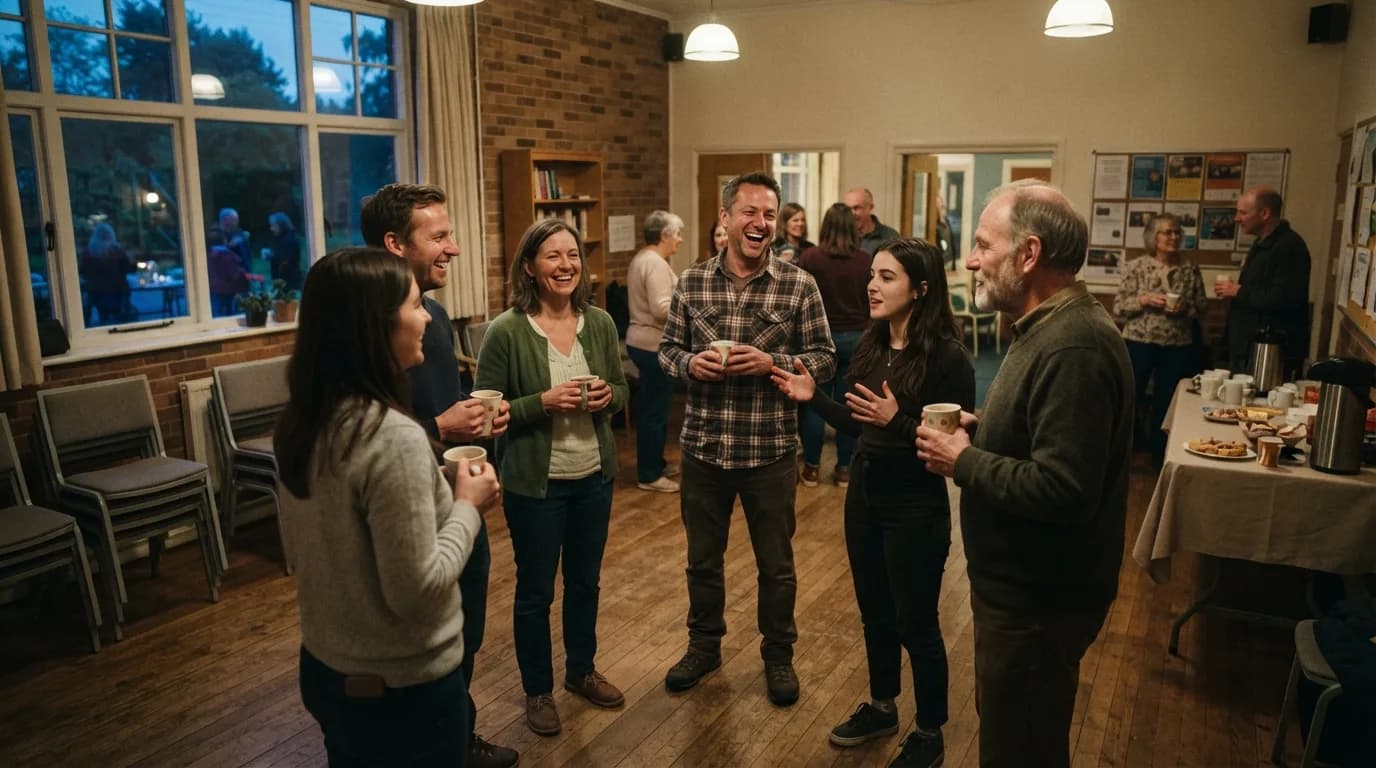
The 5 Degrees Movement is growing a network of people who come together around common interests, hobbies and life circumstances to meet and build new relationships. Our aim is to make the world smaller, one connection at a time.
In practice, that means small events across South Jersey and Philadelphia, where most people come alone.
If the numbers above describe a problem too big for any one person to fix, the encouraging part is that it does not have to be fixed alone. It needs more places where connection can happen, and more people willing to walk into them. Join the movement and be one of them.